

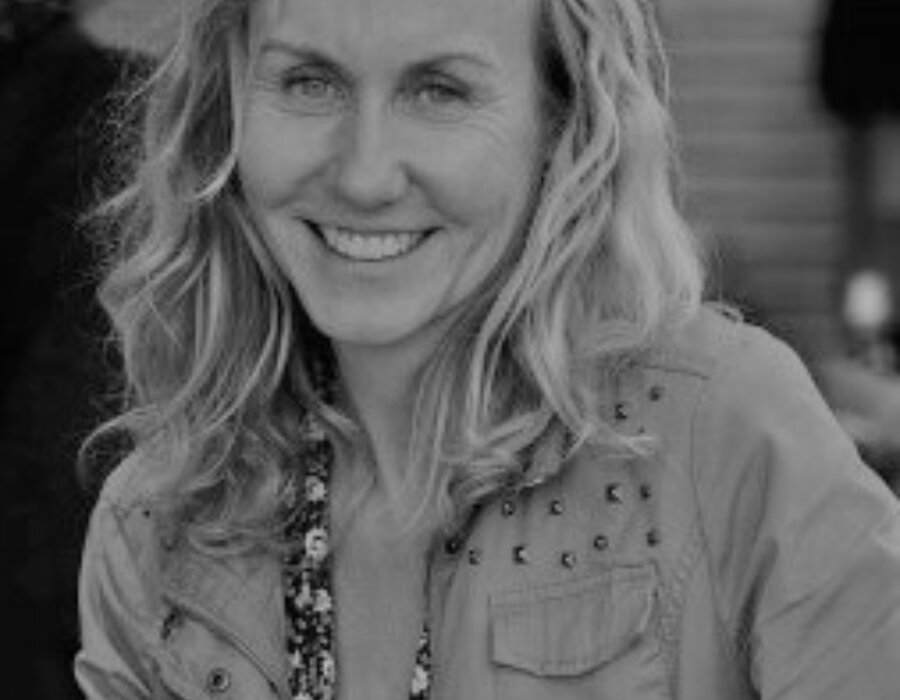
Meet Karin McCully - Dramaturgy Tutor
We sat down with Karin McCully, our Dramaturgy tutor to discuss her background in and passion for her subject. This course is taken by all our MFA students to support their understanding of the context of theatre and creating work.
As well as being our dramaturgy tutor, Karin McCully is also the Literary Manager of Rough Magic Theatre Company. Karin has a significant background in developing dramaturgical practice in Ireland (see more below). We met with her to discuss her teaching, particularly in the context of our MFA in Playwriting.
Karin, tell us a bit about you and your background.
I came from a family that had dabbled in musical theatre and I performed as a child but knew I didn’t want to be an actor. I was very academic and chose Trinity College Dublin to study languages, but I had this niggling feeling the whole way that I was giving up theatre. At Trinity, I joined Players (the drama society) and I spent a lot of my time there. I had never wanted to write plays, but I understood the craft because I did nothing but read them. Even in my language studies, I was concentrating on dramatic literature in French, German and Italian. When I was meant to be going to Kiel University in Germany to do an MA in Romantic German Literature with the aim of going on to do a PhD, the head of the German department intervened and pointed out to me that I’d spent my entire time at college in Players. She suggested I reconsider my decision - this was life changing. I began to research postgraduate degrees in the States and I came across Dramaturgy, which didn't exist as a concept in Ireland back then. I couldn’t believe this course existed - dramaturgy bridges theory and practice perfectly. The only university offering a master's degree in Dramaturgy and Dramatic Criticism was Yale. There, I discovered the joy of not being the dominant person in the rehearsal room but still being integral to the production. It gave me a lot of time to work as a production dramaturg and pursue my academic studies. It also opened up the door to literary management. Right after graduating, the artistic director of the Abbey Theatre, Patrick Mason, approached me to become their inaugural dramaturg. It was quite visionary of him, Christopher Fitzsimons was the literary manager, and he was an amazing mentor to me
Tell us about the development of dramaturgy at the time?
At the Abbey, I would hang out in rehearsal rooms, making relationships with writers and directors and I began to see dramaturgy from that point of view - not the way the American system sees production dramaturgy, but as an equal collaborator with everybody else in the room – particularly with the writer.
It was a way of lending creative and artistic support, and it happened very organically. There were young writers who were pushing to get into the Abbey at the same time, and together, we had an affinity that there was a sense of establishment, which we were 20 years younger than. It was a great time helping young writers get in the door and then creating a bond of trust. It had nothing to do with editing; I've never worked like that with a playwright. It's more about getting to know what they want, what their intentions are, what their influences are, what their ambition is, what their vision is and what that means in terms of references. I think that's what dramaturgy is in the true sense of the principle of it, that you have the knowledge that can create the context. That's what you are in the rehearsal room, you're the one who knows theatre history, you know your plays, you know the framework outside of the framework in the room - you have the bigger context.
What is the difference between Dramaturgy and Literary Management?
With dramaturgy you’re at the foundation of a production process. Whereas a literary manager is seeing the vision for the organisation - where things need to sit and where the drive needs to be in terms of the overall programme. For a literary manager in an Irish context, there's a good amount of administration. You're overseeing commissions, you are the final call on all submissions, you're reading a lot of scripts - hundreds of scripts a year. I wish we could cover both on this programme, but in a one-year course concentrating on dramaturgy, it is most useful as a tool of textual analysis for all disciplines.
With dramaturgy, you need to be completely immersed in theatre history and know how to let that benefit a production team - primarily the writer. Creating and giving context is basically what dramaturgy is - to be able to contextualise - because what happens in a rehearsal room becomes a vortex. The role of the dramaturg is to stay objective, to not be in rehearsal every day, to come in and out and gauge it. It can be quite lonely because you can't really go in with the team, you have to maintain a distance.
It's similar in literary management, which crosses over with dramaturgy in an Irish context. To fully function as a dramaturg, you have to be on an equal footing with the playwright and the director and have already built that relationship.
What does your dramaturgy course cover?
It gives you a speed run through the chronology of the canon and we try to expand that canon as much as possible because it can be restrictive. To do that, we look at contemporary responses to the classical canon such as radical Marxist feminist views from the 1970s or contemporary Irish responses and adaptations of classics. A student might say that they don't want to cover Aristotle because it’s a dead white male writer. But you can't throw them out until you know them - you must know the subject matter before you can contest it and criticise it.
Can you tell us about how your course interacts with the MFA in Playwriting?
The playwriting course is well balanced between looking at contemporary theatre practice, which is incredibly important for an emerging playwright, and dramaturgy, which looks at the roots of theatre right up to contemporary text and mixing it in. Alongside my course, the playwrights are being mentored as writers by Graham Whybrow and Thomas Conway in Contemporary Theatre Practice. When I studied dramaturgy, I found the most valuable thing I've ever had was that core understanding of text. It doesn't matter if it's a devised piece, experimental or non-text based. A dramaturg will work in liaison with the production from the start and will collaborate with them to give a written record.
What do you love about teaching and what do you find exciting about meeting emerging writers?
Oh, I love teaching - words fail me actually! It's unbelievable how much it feeds back to me, the fun that we have, the places we can go once you build trust in a room and people are safe.
To dive into any form of literature is to go deep into your own psyche and your own responses, particularly at MFA level. It's unbelievable what can happen amongst the students themselves when it takes off, what they learn from each other. In a sense, what I'm doing is curating it and making sure that everybody is in on the game.
I think it's a journey, I know that sounds sort of woo-woo and hippy, but it is! It’s also an historical journey; we're covering just about every period since the Ancient Greeks onwards. We cover a lot of social history and a lot of biographies of the playwrights, which increases as we come into the 20th century. It has that very personal aspect to it, which is balanced out by a learning curve on theory.
We interrogate objectivity, how to understand a character or plot and then exercise distance, particularly for the writer. What the MFA writers feedback to me is that it is learning the process of going into a world so that you can stand outside of that world. You immerse yourself to be equipped to remove yourself and look back.
The course obliges you to sit still, it obliges you to read. Also, when you have that conversation in class, you hear the other viewpoints and a text being brought to life in different ways or through different perceptions or different cultural viewpoints – it’s so interesting.
What kinds of people get the most value out of coming to do the course?
Don’t do this as a stopgap or because you can't decide what else to do - it is vocational at the level of an MFA.
You need to have the determination to be heard, even in opposition to something that's been put on the table. You need to have belief in the shape of your vision and in your work. You also do need to get on with people as it is collaborative process. Theatre is difficult for writers; they need incredible armour.
This course is a very big commitment and a writer contemplating it needs to ask themselves these questions: To what degree do I really want this? Why do I think I want it? What is it in my history or experience of life and theatre that makes me feel I can give this commitment? If you meet those parameters, then you're going to love it. It just takes that moment of self-interrogation.
Applications for the MFA in Playwriting are open until May 31st. You can see more on the programme at this link.