

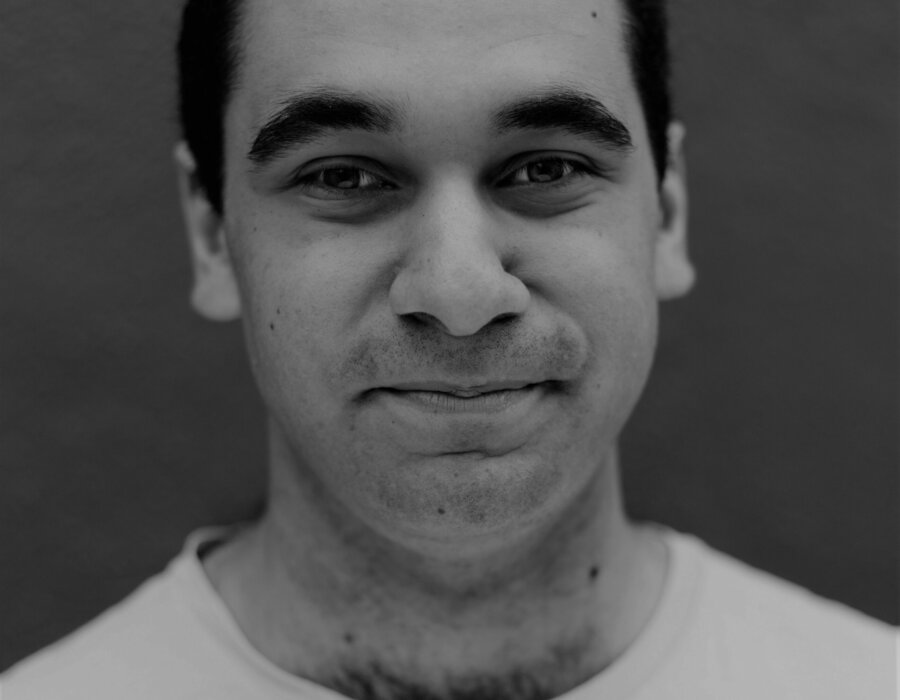
Meet MFA Playwriting Graduate CN Smith
CN Smith is a 2021 graduate of the MFA in Playwriting at The Lir Academy, he was also the recipient of the Patricia Leggett Scholarship that year.
CN, what was your interest and background in theatre and playwriting before you came to the course?
It was a bit of a roundabout route for me. I started in youth theatre when I was about 17 and was doing little bits of theatre in school. Initially, as many of us do, I thought I wanted to be an actor. With that thinking, I went then to Trinity College Dublin and did the BA in Drama and Theatre Studies.and quickly discovered that maybe performing was not my calling. So then, I wanted to be a director and I proceeded through that whole degree with that in mind. I created work in Players (Trinity’s drama society) and was doing little bits in the Scene and Heard festival around that time, I did also try out other things and was still holding on a little to performing. So, I took those four years as a bit of an experiment and an opportunity to figure out what I wanted.
I discovered writing for stage during my degree early on, but I guess I didn't gravitate towards it because it was a bit scary as it was something I hadn't really tried before, and it seemed a bit of a left-field idea. By the end of the programme, having gone through a whole final-year director's specialisation, I think it really dawned on me that life as a director is far more stressful than I thought, it didn't gel with who I am at my core, that I had been avoiding playwriting as a discipline and as an alternative path. I realised this at the end of that degree with the mentorship of Gavin Kostick (Lir MFA tutor). I was able to see that's where I needed to be, and that's why I applied for the MFA - under his advice.
How did the course help shape your practice as a writer?
I've thought about this a lot since graduating, in terms of the value it brought me, I think it was an intense focus and an immersion in craft.
Having taken a scattergun approach to my undergraduate degree, the dedicated, focused approach to craft in the MFA was so different. Taking the year to study 3 modules, and to be forced, under duress, to just read a million plays, write scenes every week, analyse the structure of things through dramaturgy; to just spend a year doing those things that are so core to the craft, to not being able to ignore them; not being able to go into tutorial and say dramaturgy is stupid and it doesn't matter and tear everything up, which is what I was doing before. But being forced to contend with those questions, and to contend with, even if it's not necessarily what I do now, and it's not necessarily the direction I want to go in, but to contend with the people who are doing it and to contend with those foundations, in a way that was not as easy to brush off, was really valuable. Even if it was a struggle and even if it was sort of frustrating at the time, once I'd made the decision to do that, I think I got a lot out of the programme. I did learn a lot. It exposed me to so much work, it was a wealth of information, and I was pushed to engage with the work as opposed to just doing enough. Part of that was the environment and part of it was that I put a lot of pressure on myself to do it right and get the most out of it - I think that was the real value.
What did you find surprising about the course?
The surprise was how much I learned about myself and the way I approach work. Some of which maybe I knew already, on a sort of granular level. The thing I learned is that I had a tendency to not go deep and drill down into things, to create a deeper understanding, but instead to expand and try to overwhelm with lots of information. I began to see an alternate approach, where I was getting in my own way and how sometimes I should just throw things out and start again.
I had anticipated learning a lot and improving my craft. But the thing that surprised me most was the degree of personal growth I underwent: the amount I learned about myself; how I tackle situations; how I go about working; and how those things can change; I don't have to take my weird idiosyncrasies for granted; they’re something that I can work with, not just under.
What have you been up to since you finished your MFA?
In tandem with the MFA, I was in the inaugural cohort of the Rachel Baptiste program and that reading was after the Scripted reading for my thesis play at The Lir Academy.
Shortly after that, I started development with Dominic O'Brien, now the Associate Director of Rough Magic, on an adaptation of The Decameron by Giovanni Boccaccio. We had presented that in the Seeds showcase in 2022, We're hoping to present that in the next year in a final version.
Right after I graduated from The Lir Academy, I took part in the Dublin Fringe Festival WEFT programme. They commissioned my play Spear, which they put on in the festival in 2022. That was later revived in a different production directed by Lir graduate Joy Nesbitt at the Corrib Theatre in Portland, Oregon, under the artistic directorship of Lir graduate Holly Griffith. We’re waiting to hear about that potentially happening again in 2027 in the UK.
Following on from Spear, I got a commission from the Abbey Theatre and I've been working on that for the past 3 years. It reached what I thought was an endpoint at the end of 2024, then I decided last year to rewrite it, so I started from scratch and I'm hoping to wind that up in the next couple of months.
Then I did a programme with Fishamble and the Irish Repertory Theatre called The Transatlantic Commissions in 2023. Those were short commissions of 20-minute, 20-minute excerpts or 20-minute plays, with myself and 3 other writers. They were presented in Dublin, New York, San Francisco and LA in short readings. In 2024, they commissioned the full project. I wrote my play Corktown as part of that and we're looking at avenues to try and put that on.
In 2023, I was a very small part of a big project with Veronica Coburn working with Draíocht in Blanchardstown called Nest. It was a follow-on from Home Theatre, created in 2018.
The project worked with people between the ages of 8 months and 21 years in Dublin 15, and it involved the writers spending time with one person within that age range for 3 days and then writing a play over a day or two. I spent time with a 17-year-old young man, a soccer player and I wrote Life is Ball - available online (click here). It was really beautiful to work on, it was such a great experience.
The other thing that just finished its first phase was that I was selected as one of the Rough Ideas playwrights for Rough Magic's callout. That was a year of working on an unfinished play of mine with their Literary Manager (and Lir tutor), Karin McCully, to bring it to a first draft. They did a reading of a segment of that at the end of last year.
Would you recommend the course?
I would but not to just everyone. I think if you're ready and willing to give yourself over to the barrage of information, as well as the waves of content, craft and deep focus; if you're ready to set your ego aside and grow, then yes, for sure. But that's not for everyone, and everyone comes to that point through different routes and at different times. For me, I think it was the right time, so I would definitely recommend it if that's where you find yourself.